Khamenei Funeral Turns Fiery as Mourners Chant for Trump’s Head
The funeral of Iran’s slain Supreme Leader Ayatollah Ali Khamenei was already expected to be dramatic. It became something sharper. In Tehran, mourners did not simply cry, pray, or wave flags. Some turned the procession into a roaring political message aimed directly at U.S. President Donald Trump.
In one video reported by Iran International, mourners chanted, “We don’t want a deal, we want Trump’s head,” during a funeral procession for Khamenei. The chant captured the raw mood around the ceremonies: grief, rage, nationalism, and open calls for revenge all tangled together in one volatile public moment.
The funeral events followed Khamenei’s death in a U.S.-Israeli strike on February 28, according to multiple reports. The ceremonies were delayed by war and stretched across several cities, including Tehran, Qom, Najaf, Karbala, and finally Mashhad, Khamenei’s birthplace and home to the Shrine of Imam Reza.
A Funeral Becomes a Show of Defiance
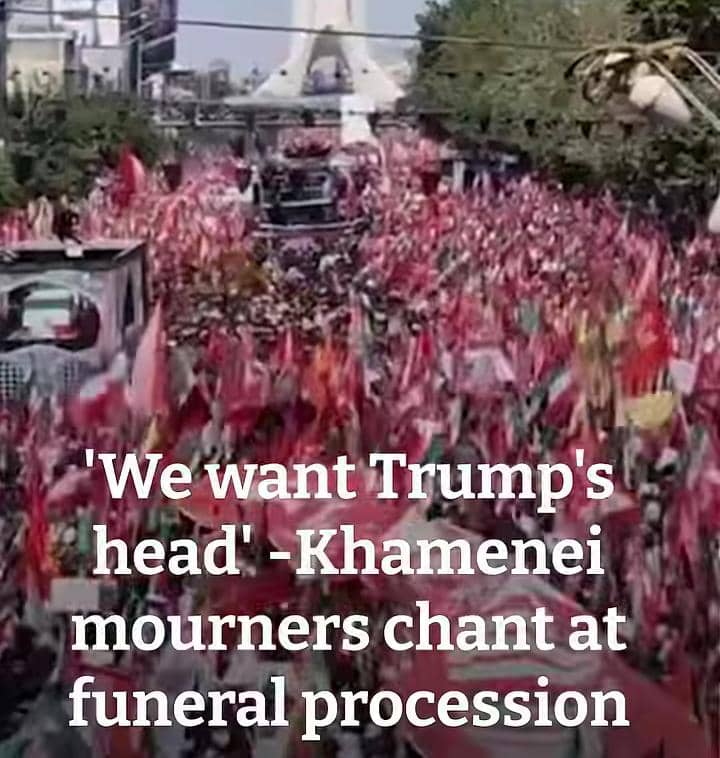
Iran’s leadership clearly wanted the funeral to be more than a burial. It was staged as a national display of grief and endurance, with black-clad crowds, Iranian flags, portraits of Khamenei, and red banners symbolizing vengeance. Reuters reported that Khamenei’s body was carried through crowded Mashhad streets toward the Shrine of Imam Reza, while mourners pressed in close behind the procession.
The tone was not quiet mourning. It was loud, choreographed, and deeply political. Reuters reported that crowds at the Mashhad burial shouted threats toward Trump, including, “I swear by the blood of the Supreme Leader, Trump, we will kill you!” Some women also held placards reading “Kill Trump.”
That anger was also visible earlier in Tehran. It was reported that at the Imam Khomeini Grand Mosalla, mourners waved red flags and chanted slogans calling for revenge. One English-language message seen near the stage read, “Kill Trump.”
The Associated Press reported that Iran’s top officials attended the prayers, including President Masoud Pezeshkian, Parliament Speaker Mohammad Bagher Qalibaf, Revolutionary Guard head Gen. Ahmad Vahidi, and Quds Force commander Esmail Qaani. Khamenei’s sons Masoud, Meysam, and Mostafa were also present. But the most closely watched absentee was Mojtaba Khamenei, the new supreme leader and Khamenei’s son, who has remained out of public view.
The Chant That Cut Through the Procession
The phrase “We don’t want a deal, we want Trump’s head” landed because it collided with another reality: Iran and the United States have still been tied to talks, ceasefire efforts, and disputes over the Strait of Hormuz. Iran International described the chant as a sign of the gap between public revenge rhetoric and the Islamic Republic’s parallel negotiation track with Washington.
That contrast matters. On the street, supporters were shouting for vengeance. Behind the scenes, officials have been navigating a far more complicated game involving war, sanctions, shipping lanes, and Iran’s nuclear program. It was reported that U.S.-Iran talks appeared to be on hold until after Khamenei’s burial.
The funeral also became a platform for hardline voices. According to Mohammad Rasouli’s quote, a poet speaking before the prayer reading said, “Trump’s murder is our responsibility,” a scripted and authorized remark that drew cheers from much of the crowd.
Another official, Mohammed Bagher Zolghadr, secretary of Iran’s national security council, framed the chants as two messages from the crowd: “resistance against enemies” and “revenge for the blood of the martyred leader of Iran.”
Not every quote came from the stage. AP spoke with Gholamreza Sabooni, a 29-year-old grocery worker, who said he came to the funeral “to shout and seek revenge.” Another mourner, Mohammad Reza Sharifi, said Iran’s foreign policy should not dishonor Khamenei’s blood and that he expected a “serious response” from the government.
Why This Moment Matters Now

The funeral came at a dangerous moment. It reported that Trump recently declared the U.S.-Iran truce “over” and warned that the U.S. was preparing to hit Iran “hard” again. At the NATO summit in Turkey, Trump also called Iran’s leaders “crazy” and “lunatics,” while saying he was “number one on the kill list for Iran.”
Trump has also used the conflict to boast about U.S. military strength. He quoted him as saying, “We’ve had tremendous success,” before adding that the U.S. had “wiped out” Iran’s military.
Inside Iran, Khamenei’s death has created both a leadership transition and a propaganda moment. Mojtaba Khamenei was appointed supreme leader after his father’s death, but reports say he has not appeared publicly since the strike. Al Jazeera reported that a statement attributed to him thanked Iran’s fighters and pledged that the country would continue fighting.
That silence from the new leader has only added to the mystery of the funeral. The public saw the old leader’s coffin, the old slogans, the old enemies, and the old revolutionary stagecraft. What they did not see was the man now supposed to carry the system forward.
So the chant was not just an angry line from a crowd. It was a snapshot of where Iran stands: wounded, defiant, divided, and locked in a dangerous standoff with Washington. Khamenei’s funeral was meant to close one chapter of Iranian history. Instead, with mourners shouting Trump’s name and officials promising resistance, it looked more like the opening scene of the next confrontation.