Michigan Democrat Says She Can No Longer Reconcile Christianity With Her Party
Michigan state Rep. Karen Whitsett did not quietly announce her retirement with a polite press release and a list of legislative accomplishments. Instead, the Detroit lawmaker dropped a faith-and-politics thunderclap, declaring that she could no longer reconcile her understanding of Christianity with the Democratic Party.
Whitsett said she would not seek reelection after her current term and would never run for public office again. She described the decision as spiritual rather than strategic, saying, “This is not a political calculation. It’s a spiritual decision.”
Her announcement quickly traveled beyond Michigan because it touched one of America’s oldest political arguments: Can religious faith comfortably coexist with a political party whose platform a believer considers morally unacceptable?
Whitsett’s answer was a firm no, at least for herself. But the larger picture is considerably more complicated.
Whitsett says the party crossed her biblical boundaries
Whitsett represents Michigan’s 4th House District, covering parts of Detroit. In her March 2 announcement, she said she planned to remain involved in civic affairs and support leaders across party lines, even though she was walking away from elected office.
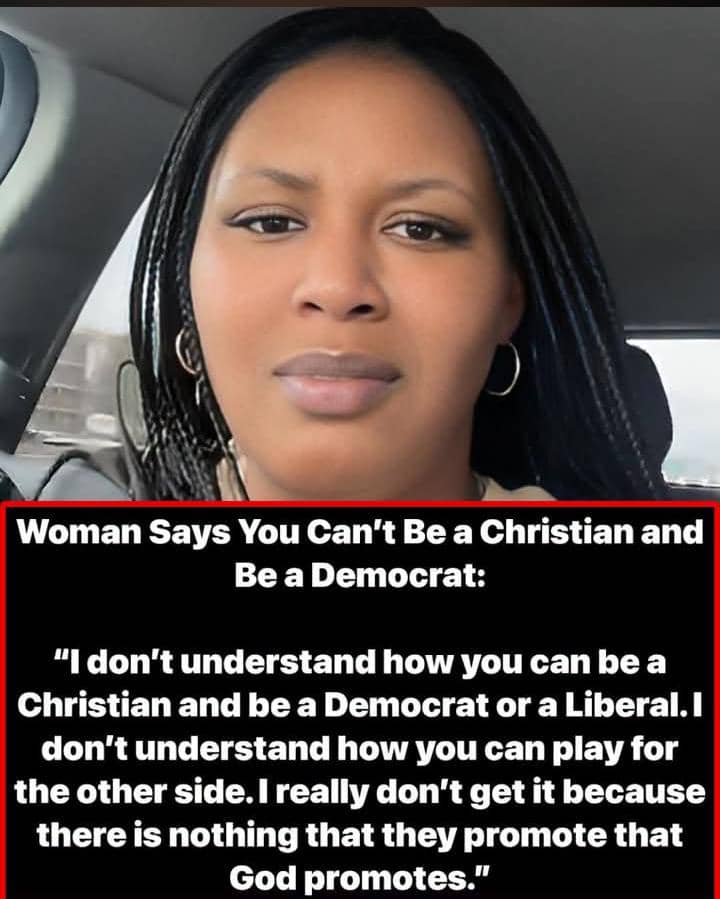
The lawmaker said her disagreement with Democrats centered largely on abortion, LGBTQ issues and policies involving gender identity. She argued that those positions conflicted with her interpretation of Scripture, adding, “I cannot reconcile that platform with Scripture.”
Whitsett also credited Lionheart Church, a congregation based in Austell, Georgia, that she and her husband attend online, with helping shape her renewed religious convictions. She said her allegiance now belonged to Jesus Christ rather than political approval.
This was not Whitsett’s first collision with her party.
In 2023, she became a crucial Democratic holdout during negotiations over Michigan’s Reproductive Health Act. She opposed provisions that would have allowed Medicaid funding for abortions and removed the state’s 24-hour waiting period. Because Democrats held only a narrow House majority, lawmakers ultimately passed a reduced version of the package after dropping provisions Whitsett opposed.
Whitsett has also presented herself as unwilling to vote automatically with party leaders. That independent streak brought her attention from conservatives but repeatedly placed her at odds with Michigan Democrats.
Her latest announcement therefore did not appear from nowhere. It was the loudest moment in a dispute that had been building for years.
Michigan Democrats answered with two icy words
Michigan Democratic Party Chair Curtis Hertel did not respond with a diplomatic farewell or an invitation to discuss theological differences.
“Good riddance,” Hertel said.
He called Whitsett’s departure a positive development and said the party wanted to elect a representative who would show up for work. The response shifted the story from a personal declaration of faith into a full political breakup, complete with slammed doors and no attempt to hide the bitterness.
Still, Whitsett did not announce that she was becoming a Republican. She said she would support leaders across party lines who shared her priorities, while later telling Fox News Digital that she could no longer support the Democratic Party. Her term is expected to continue until early 2027.
That distinction matters. Whitsett’s statement was not simply a routine party switch designed to improve her chances in another election. She said she was leaving electoral politics entirely.
Her words also reflected a genuine political divide. Abortion rights and protections for LGBTQ Americans remain major Democratic priorities, while conservative Christian organizations frequently argue that those policies conflict with traditional interpretations of the Bible.
For Whitsett, compromise had become spiritually unacceptable. For Democratic leaders, her resistance had become politically exhausting.
Christianity remains larger than either political party
The most provocative interpretation of Whitsett’s declaration is that Christians cannot be Democrats. However, the evidence shows that millions of Christians do, in fact, identify with or vote for the Democratic Party.
Pew Research Center reported in 2024 that approximately 54% of Democrats and Democratic-leaning voters identified as Christian. A later Pew analysis found especially strong Christian identification among Black Democrats, with 76% describing themselves as Christians.
Voting patterns also vary dramatically among Christian communities.
According to AP VoteCast, roughly eight in ten White evangelical Christians supported Donald Trump in the 2024 presidential election. However, approximately eight in ten Black Protestant voters supported Democrat Kamala Harris. Those figures show that Christianity does not produce one automatic political conclusion. Race, denomination, theology, history and policy priorities all shape how believers vote.
Democratic clergy members have also pushed back against the idea that conservative politics owns Christianity. In 2026, three pastors ran for Congress as Democrats in Iowa, while other religious Democrats argued that healthcare, poverty reduction, immigration and social justice were expressions of their faith.
Melissa Deckman, CEO of the Public Religion Research Institute, said believers have “different ways to think about how our faith informs our policy.”
That is the tension at the center of Whitsett’s story. Two Christians can read the same Bible, pray to the same God and reach sharply different political conclusions. One may focus primarily on abortion and sexual ethics. Another may emphasize healthcare, poverty, racial justice or welcoming immigrants.
Whitsett has every right to say the Democratic platform no longer fits her religious convictions. Her announcement offers a revealing look at how political loyalty can collapse when it collides with personal faith.
But her conclusion remains her own. Christianity has never fitted neatly inside a red or blue campaign sign, no matter how confidently either party tries to claim it. The more interesting question is not whether someone can be both Christian and Democrat. It is whether American politics still leaves room for believers who refuse to let a party define their entire faith.