New York Sculptor’s $100,000 Charlie Kirk Statue Draws Attention but No Buyer
A monument built to command attention is creating an unexpected spectacle before it reaches a public square.
New York artist Sergio Furnari says he invested approximately $100,000 of his own money in a life-size Charlie Kirk statue, only to discover that no organization, wealthy supporter, or private collector has agreed to buy it.
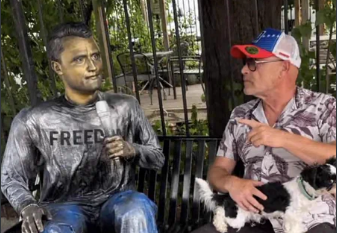
The steel and resin sculpture depicts the late Turning Point USA co-founder seated with a microphone in his hand, recalling the campus debates that helped make him one of America’s most recognizable conservative activists.
Furnari believed the project would attract financial support, but he now says the cost has placed him in a difficult financial position.
An Uncommissioned Project With a Six-Figure Cost
Unlike many public monuments, the Charlie Kirk statue was not ordered by a government agency, university, or political organization. Furnari began the project independently and covered the materials and labor himself, apparently assuming that donors would eventually help reimburse him.
The Sicily-born artist, who has lived in New York City for roughly 35 years, reportedly spent more than five months creating the sculpture.
It was constructed with an internal metal frame and a durable resin coating, materials Furnari selected to produce a strong, detailed monument suitable for public display.
The figure stands close to Kirk’s height and shows him wearing a sweatshirt marked with the word “FREEDOM.”
A microphone in one hand connects the sculpture to Kirk’s public appearances, where he frequently debated students and promoted conservative ideas on college campuses.
Furnari has said the statue was made by hand and designed to appear monumental rather than simply realistic. Although he has displayed the work during media appearances, the attention has not yet produced a confirmed purchaser or permanent home.
Artist Says the Statue Is About Free Speech
Furnari has emphasized that creating the monument did not mean he supported every position Kirk expressed. He said he disagreed with the activist on several political issues, including Kirk’s comments concerning Palestinians.
Instead, the sculptor described the project as a commemoration of free speech, democracy and a politically significant moment in American history. He also said he wanted to show support for Kirk’s widow, Erika Kirk, following the activist’s death.
The artist compared his reasons for creating the statue with the broader artistic tradition of preserving important people and moments through sculpture. His argument is that a monument can recognize someone’s place in public life without representing complete agreement with that person’s beliefs.
That distinction has done little to quiet the reaction surrounding the Charlie Kirk statue. Furnari said he has received hostile messages, including comments from people threatening to damage or disrespect the sculpture if it is publicly displayed in New York.
Fundraising Falls Short of Expectations
Furnari launched an online fundraising campaign in hopes of recovering some of his investment and financing future displays. The campaign initially sought $150,000, with the artist suggesting that additional support could allow the statue to tour different locations.
By Tuesday morning, the fundraiser had collected approximately $8,225, far below the amount Furnari said he spent. The total had increased from the roughly $1,400 reported several days earlier, but it remained a small portion of his stated production costs.
The artist has openly expressed disappointment with the response. He had expected prominent donors and supporters of Kirk to help pay for the work, but those contributions did not arrive at the level he anticipated.
His frustration was compounded by an accident inside his studio. Furnari said he broke his foot after tripping over a roll of tape while working around the sculpture, briefly prompting him to question whether the project was cursed. He later rejected that suggestion and described the statue as blessed.
The financial struggle highlights the risk artists face when producing politically charged work without a commission. Public interest, social media engagement and ideological support do not necessarily translate into enough money to cover materials, labor, transportation and exhibition costs.
Times Square Unveiling Planned for September
With no permanent buyer secured, Furnari plans to bring the Charlie Kirk statue to Times Square on September 10, 2026. The date marks one year since Kirk was fatally shot during a public event at Utah Valley University.
The artist has said the unveiling is scheduled for 2:23 p.m., the reported time of the shooting. He plans to place the sculpture high on a vehicle so it can be seen above crowds in one of New York City’s busiest public spaces.
Furnari has also discussed inviting New York City Mayor Zohran Mamdani to the event. The politically symbolic invitation could draw additional attention because the statue celebrates a prominent conservative figure while being displayed in a heavily Democratic city.
Turning Point USA had not publicly committed to supporting the monument when the unveiling plan was announced. There was also no confirmed indication that Kirk’s family, political allies, or affiliated organizations intended to purchase it.
Furnari eventually hopes to produce a more permanent version in stainless steel. He has estimated that such a project could cost approximately $250,000, making it unlikely without major financial backing.
The Political History Behind the Monument
Kirk, 31, was shot and killed on September 10, 2025, while hosting an outdoor political discussion at Utah Valley University. He had co-founded Turning Point USA and became influential among young conservatives through campus organizing, media appearances, and online commentary.
Tyler Robinson, 23, was later arrested and charged in connection with the killing. At the time of the latest reporting, Robinson had not entered a plea, and the criminal proceedings remained unresolved.
The planned Times Square appearance may determine whether Furnari’s costly gamble finds a wider audience or remains a privately financed work without a home. For now, the Charlie Kirk statue occupies an unusual position between art, politics and commerce: widely discussed, deeply divisive and still waiting for someone willing to pay for it.