Obama Presidential Center in Chicago: Black Excellence, Memory Politics, and the Battle Over Legacy, Space, and Power
A Landmark That Doesn’t Just Open It Rewrites Memory
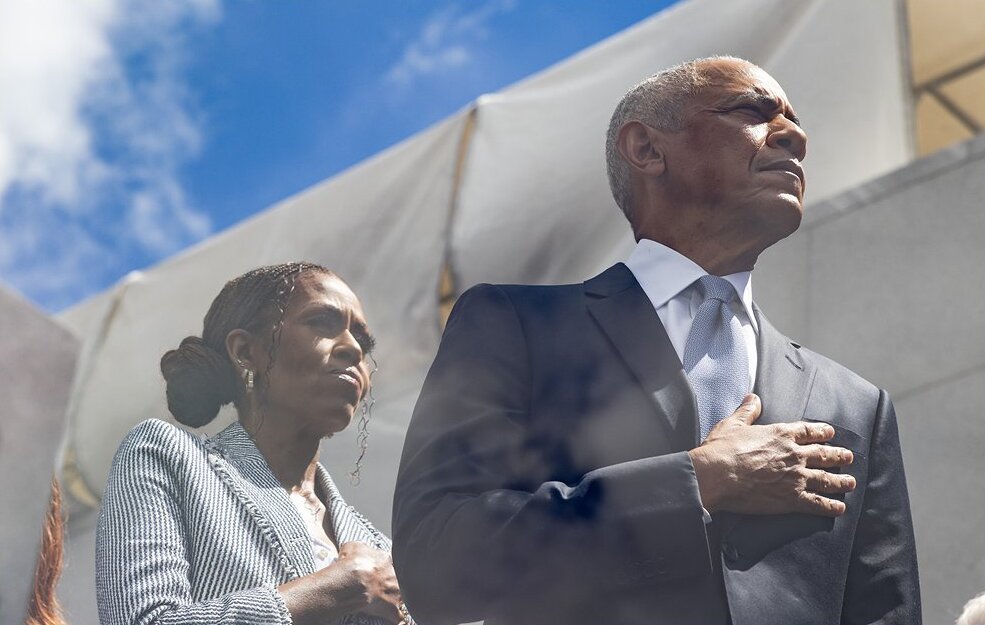
Barack Obama Presidential Center, Public domain, via Wikimedia Commons Licensed under Grand opening of the Barack Obama Presidential Center
The Obama Presidential Center in Chicago does not function as a passive museum opening. It operates as a cultural event, a political statement, and a contested public symbol all at once. Situated in Jackson Park on the South Side, the campus immediately enters national conversation not as architecture alone, but as memory made physical.
Visitors describe the center as a celebration of Black excellence, and that phrase has become the emotional anchor of the opening. It captures pride, representation, and historical weight. Yet beneath that pride lies a more complex story about urban space, political legacy, and the cost of turning history into infrastructure.
The center stands as a rare moment where architecture, politics, race, and economics converge in a single physical location, and immediately split into competing interpretations.
The Gentrification Paradox Hidden Inside “Black Excellence”
The most difficult tension surrounding the Obama Presidential Center is not political; it is spatial and economic.
On one hand, the project represents a monumental achievement for Black political history. On the other hand, it sits inside neighborhoods where long-term Black residents face rising housing pressure, insurance increases, and land speculation.
This contradiction produces what can be described as a gentrification paradox of representation:
- A Black political legacy is being permanently honored.
- In a Black neighborhood experiencing economic displacement pressure
Real estate activity around Woodlawn, Hyde Park, and South Shore has already reflected anticipation of increased tourism and global attention. Investors rarely wait for full completion; they price in future value early. That dynamic creates a slow economic shift that does not require demolition, only market expectation.
The result is a painful question embedded in the landscape:
Can symbolic Black excellence remain rooted in a community that may no longer be financially accessible to many of its original residents?
The Presidential Brand Industrial Complex
The Obama Presidential Center is also part of a much larger American system: the transformation of presidents into long-term cultural brands.
Modern presidential centers are no longer solely archival spaces. They are:
- Tourism engines
- Educational ecosystems
- Fundraising institutions
- Political memory machines
In this sense, Obama’s center joins a broader institutional pattern that includes Clinton, Bush, and future presidential legacies yet to be built.
What makes the Obama version distinctive is scale and intent. The campus is not designed as a single museum structure but as a civic district. That expands the role of presidential legacy from preservation into ongoing public production.
In effect, the question is no longer:
“How do we remember a president?”
But instead:
“How does a president’s legacy continue to operate in public life decades after leaving office?”
Architecture as Silent Political Messaging
The design of the Obama Presidential Center is not neutral. It functions as visual rhetoric.
The central tower, with its sharp geometric presence, communicates authority and permanence. Surrounding green spaces and open civic areas suggest accessibility and democratic participation. The contrast between monumentality and openness is deliberate.
We can interpret the campus architecture as a three-layer message:
- Vertical massing → presidential authority and permanence
- Open public ground → civic inclusion and accessibility
- Integrated programming spaces → education as legacy continuation
Architecture here does not simply house memory; it shapes it.
Even criticism of the design becomes part of its political function. A controversial building guarantees attention, and attention sustains legacy visibility.
The Memory War: Competing Versions of Obama
The Obama Presidential Center is not entering a neutral historical space. It is entering an active memory conflict.
Three dominant interpretations of Obama continue to coexist:
1. The Hope Narrative
A presidency defined by:
- economic recovery framing
- symbolic racial breakthrough
- global diplomatic reset
- calm institutional tone
2. The Institutional Critique Narrative
A presidency viewed as:
- elite political consolidation
- incremental reformism
- unfulfilled structural change
3. The Transitional History Narrative
Obama as:
- bridge between pre-polarized and hyper-polarized America
- The last president of relative bipartisan normalcy
The center does not resolve these narratives. Instead, it freezes them into physical form.
Once history becomes architecture, interpretation becomes permanent disagreement.
Tourism Economy vs Local Reality
One of the least discussed but most consequential dynamics is the split between the visitor economy and the resident economy.
The Obama Presidential Center is expected to attract:
- national and international tourism
- cultural events and conferences
- educational visits
- media attention cycles
However, local residents measure impact differently:
- rent stability
- property tax pressure
- business displacement risk
- access to long-term housing
This creates a dual economy within the same geographic area.
In practical terms:
Visitors experience the center as a destination. Residents experience it as a market force.
That divergence will determine whether the project is remembered as a community investment or as a source of structural displacement pressure.
The Political Contrast That Never Leaves the Room
Even without direct reference, the Obama Presidential Center exists in constant comparison with Donald Trump’s political identity.
Supporters often describe Obama-era leadership as:
- measured
- institutionally respectful
- diplomatically stable
Critics of Trump amplify this contrast, turning the center into a symbolic counterweight in America’s political imagination.
But the deeper dynamic is not personality, it is narrative control.
The center allows Obama’s legacy to remain active in public space while Trump’s legacy remains primarily political and media-driven.
That difference shapes how memory is constructed:
Obama is being archived in architecture. Trump is being accused of controversy.
The Civic Design Paradox: Open Space That Still Creates Boundaries
The campus is designed with openness in mind, but architectural openness is never absolute.
Public plazas, gardens, and museum grounds suggest accessibility, yet operational rules, security zones, programming schedules, and ticketed areas inevitably shape how freely space is used.
This creates a subtle paradox:
- The center is physically open.
- But socially structured and curated
In civic design terms, it is a managed openness model in which participation occurs within controlled frameworks.
That raises an important question for long-term evaluation:
Who defines access in a space built to represent democratic ideals?
Visual Systems of Legacy: Why the Center Feels Different
Unlike traditional presidential libraries, the Obama Presidential Center prioritizes experience over archival neutrality.
It blends:
- storytelling environments
- immersive exhibits
- symbolic landscaping
- civic programming spaces
- community-facing facilities
This creates a hybrid identity: part museum, part cultural campus, part political philosophy in built form.
The effect is not just remembrance; it is emotional reinforcement of narrative identity.
The Real Test Is Not Opening Day, It Is the Next 20 Years
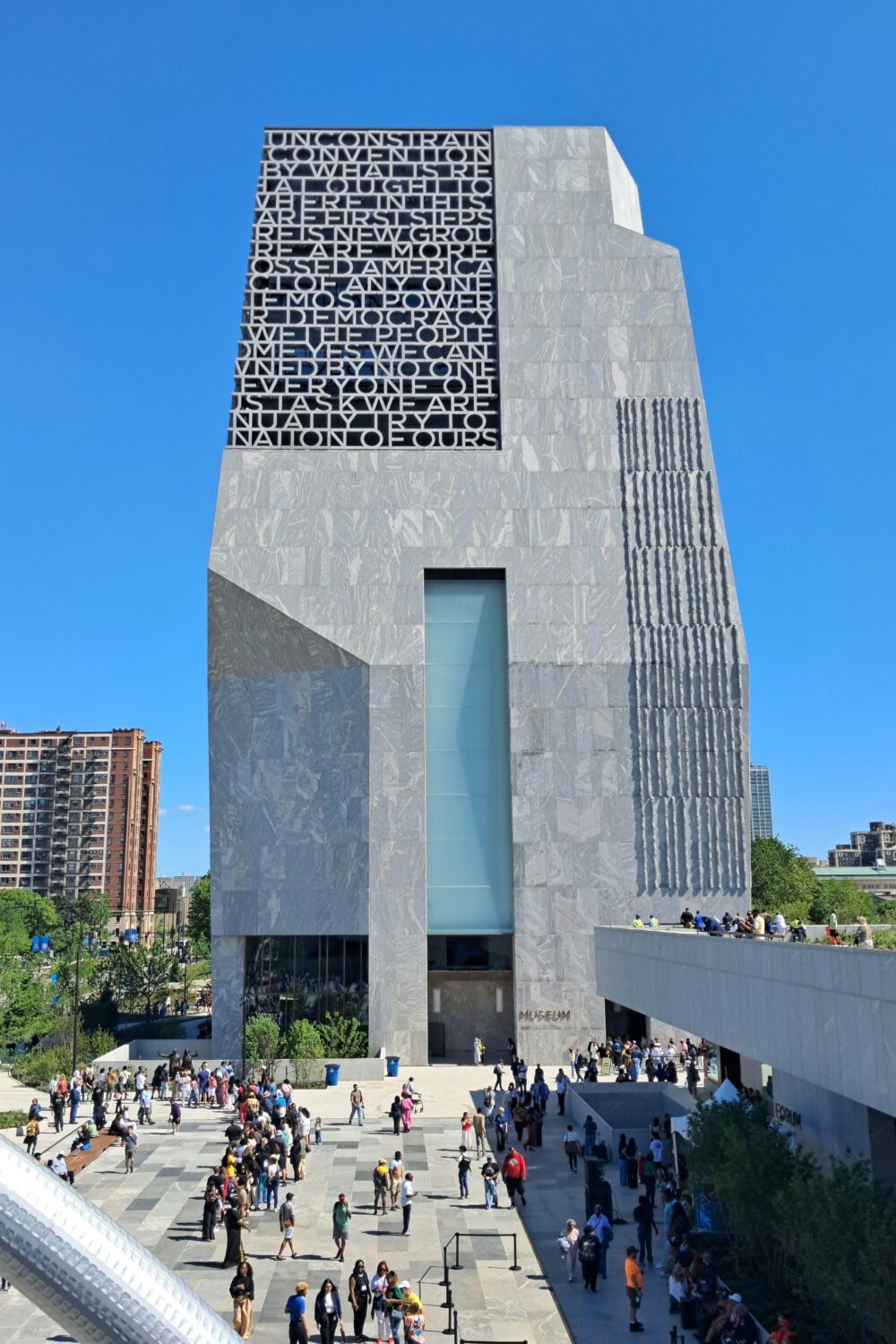
AlphaBeta135, CC0, via Wikimedia Commons Licensed Under Grand opening of the Barack Obama Presidential Center
Opening ceremonies produce narrative clarity. Long-term civic impact produces complexity.
The Obama Presidential Center will ultimately be judged on:
- whether surrounding neighborhoods remain affordable
- whether local residents benefit economically
- whether programming remains genuinely accessible
- whether it becomes a living civic space or a symbolic destination
Legacy institutions often begin as monuments and evolve into ecosystems or into static tourist anchors disconnected from their surroundings.
The difference will not be decided by visitors, politicians, or media coverage. It will be decided slowly, block by block, rent cycle by rent cycle, program by program.
A Monument Built Inside a Conversation That Has Not Ended
The Obama Presidential Center does not conclude the story of Barack Obama. It extends it into physical space while embedding it inside unresolved national tensions.
It is simultaneously:
- a celebration of representation
- a catalyst for economic anxiety
- a political memory machine
- and a civic experiment in democratic storytelling
That combination is what makes it significant.
It does not ask America to agree on Obama’s legacy. It asks America to continue arguing about it this time in stone, glass, and public space.