Outrage Erupts After Confederate Flag Appears at Trump’s Great American State Fair, North Carolina Pavilion
A celebration designed to sell America on unity has instead handed North Carolina a political firestorm. The controversy began inside the North Carolina exhibit at President Donald Trump’s Great American State Fair in Washington, D.C., where a video board displayed a Confederate flag before the image was removed.
The fair, running from June 25 through July 10 on the National Mall, was promoted as a major America 250 showcase with pavilions representing every U.S. state and territory. But one screen in one booth quickly turned the patriotic display into a national argument over history, race, memory, and who gets to represent a state before the country.
A Flag Appeared, Then the Backlash Followed
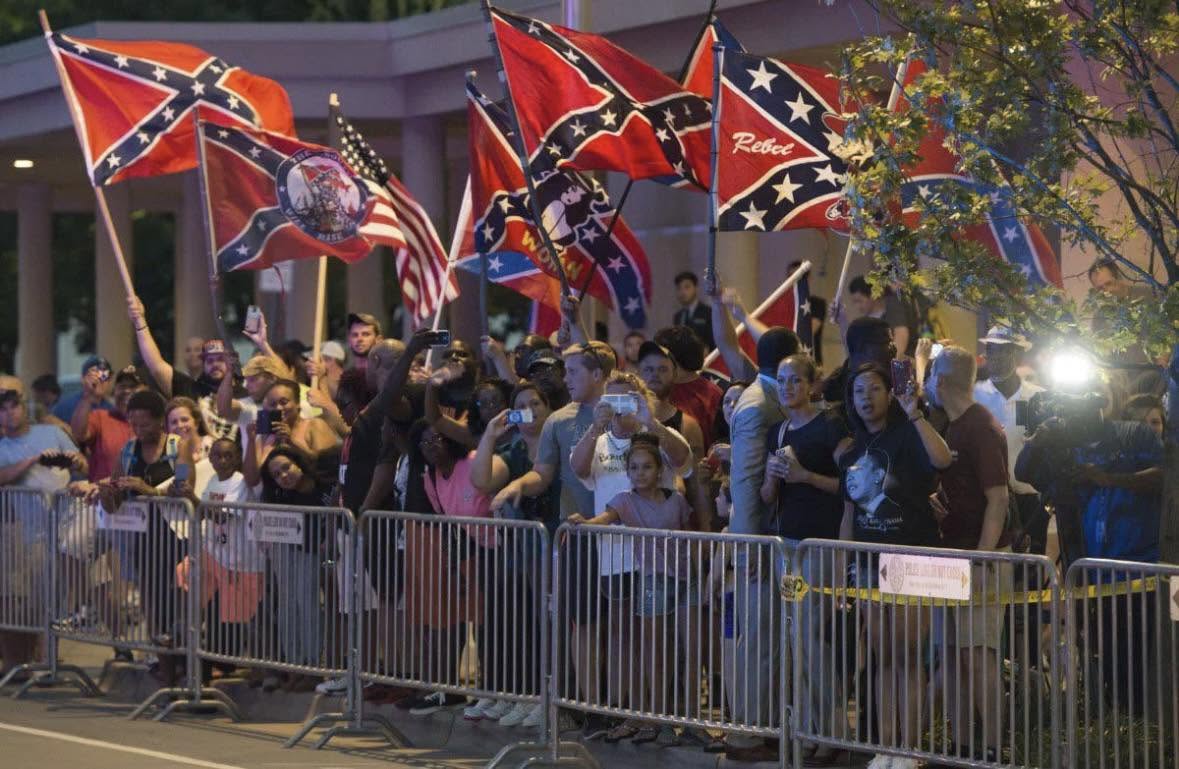
The display was not a small detail lost in the corner of a crowded exhibit. A video board in the North Carolina pavilion showed the Confederate flag, and the image drew immediate attention. By late Friday afternoon, the video had been removed. Pavilion organizers later said the image was “unapproved” and that they removed the video once they became aware of it.
That explanation did little to quiet the reaction. For many Americans, the Confederate flag is not a neutral historical image. It is tied to slavery, the Civil War, Jim Crow, segregationist politics, and modern white supremacist movements. Supporters sometimes frame it as Southern heritage, but civil rights groups and many historians have long argued that its public display carries a painful racial message far beyond nostalgia.
That is why the image hit harder than a normal event mistake. It appeared at a fair marketed around America’s 250th birthday, inside a pavilion meant to celebrate North Carolina’s role in the nation. Instead, critics saw a symbol that many believe dishonors both the state and the idea of national unity.
North Carolina’s Governor Condemns the Display
North Carolina Gov. Josh Stein’s office quickly rejected the display and said the flag did not represent the state. A spokesperson said America 250 was supposed to be about unity, while the Confederate symbol did the opposite. Stein’s office also said North Carolina was hosting its own July Fourth America 250 celebration in Raleigh focused on equality, freedom, and inclusion.
The governor’s response was important because North Carolina’s official state government was not behind the Washington pavilion. The state had declined to sponsor a booth at the Great American State Fair, citing expenses, while private sponsors stepped in to create the exhibit.
That detail makes the story even more uncomfortable. A display representing North Carolina appeared in the nation’s capital, but the state itself says it was not officially responsible for it. For residents who do not want their state reduced to Confederate imagery, that distinction matters.
Mt. Olive Pickles Pulls Out
The backlash grew when Mt. Olive Pickle Company, one of North Carolina’s most recognizable brands, withdrew from the exhibit. The company said it had agreed to participate in a display representing the best of North Carolina, but it was unaware that a Confederate flag image would appear in the video. Mt. Olive then ended its participation, saying the company stands for human dignity, opportunity, and freedom.
That move gave the controversy a sharper business angle. Mt. Olive is not a fringe political actor. It is a North Carolina company with deep roots and broad consumer recognition. Its withdrawal turned the incident from a pavilion problem into a reputational test for everyone connected to the exhibit.
In today’s climate, brands rarely get to stay silent when a controversy involves race, identity, and public symbolism. Mt. Olive chose separation. That decision drew praise from some critics of the display and anger from others who accused the company of giving in to pressure.
A Celebration of Unity Meets a Divided America
The Great American State Fair was built to look like a coast-to-coast celebration. The White House promoted the event as a large National Mall showcase featuring pavilions for states and territories, performances, rides, games, food, and exhibits that tell the story of America.
But the Confederate flag controversy exposed the deeper challenge facing any national birthday party in 2026: Americans do not all agree on what should be celebrated, what should be confronted, and what should be left behind.
The fair itself had already faced questions about politics and participation. The Associated Press described the event as run by Freedom 250, an organization created by President Trump to oversee official events for his administration, and noted tension with America250, the congressionally created group originally designed to plan the semiquincentennial. AP also reported that some states did not fully participate, citing concerns including cost, scheduling, or politicization.
Against that backdrop, the North Carolina flag incident became more than a one-day embarrassment. It became a symbol of the wider problem: a celebration advertised as a celebration of national unity can quickly become another stage for America’s unresolved fights.
Why This Hit North Carolina So Hard
North Carolina’s identity is bigger than any one symbol. It is a state of military families, universities, farms, banking centers, tech hubs, mountain towns, coastal communities, Black history, Native history, immigrant communities, barbecue traditions, basketball rivalries, and fast-growing cities like Charlotte, Raleigh, Durham, and Greensboro.
That is why critics reacted strongly to the idea that the Confederate flag would appear inside a pavilion representing the state at a national event. To them, it felt like a step backward and a narrow version of North Carolina, presented to millions.
The image also landed at a time when public displays of Confederate symbols remain deeply contested across the South. Some defenders call them history. Opponents argue that public celebration of those symbols often ignores the enslaved people, Black families, and civil rights struggles tied to that same history. The issue is not whether the Confederacy existed. It did. The issue is where and how its symbols appear, especially in spaces designed to represent everyone.
Organizers Say It Was Not Approved
The North Carolina pavilion’s statement sought to contain the damage by stating that the image had not been approved. Organizers said they removed the video and began reviewing how it happened. That may answer one operational question, but it does not answer the larger public one: How did such an image make it into a state-branded exhibit at a high-profile national celebration in the first place?
For critics, “unapproved” is not enough. They want accountability, stronger review, and clearer standards for what belongs in a public-facing state exhibit. For defenders of the display, the reaction is another example of political sensitivity around Southern history. Between those two views sits the central tension of the story: America can celebrate its birthday, but it cannot escape its history.