Florida’s ‘Alligator Alcatraz’ immigration detention center has closed, governor says
Florida’s controversial “Alligator Alcatraz” immigration detention center has closed, Gov. Ron DeSantis says, ending one of the most politically charged detention experiments in the country after nearly a year of fierce debate, legal pressure, environmental alarm, and national attention.
The facility, built in the Florida Everglades on an isolated airstrip, became a symbol of the state’s hard-line immigration posture almost as soon as it opened. Supporters saw it as a fast, aggressive answer to federal immigration enforcement demands. Critics saw something very different: a hastily built detention compound in a fragile ecosystem, surrounded by questions about safety, legal access, public spending, and humane treatment.
Now that the site has shut down, the central question is no longer whether Alligator Alcatraz will remain open. The deeper question is what its brief life reveals about the future of immigration detention in America.
A Remote Everglades Detention Center Becomes a National Flashpoint
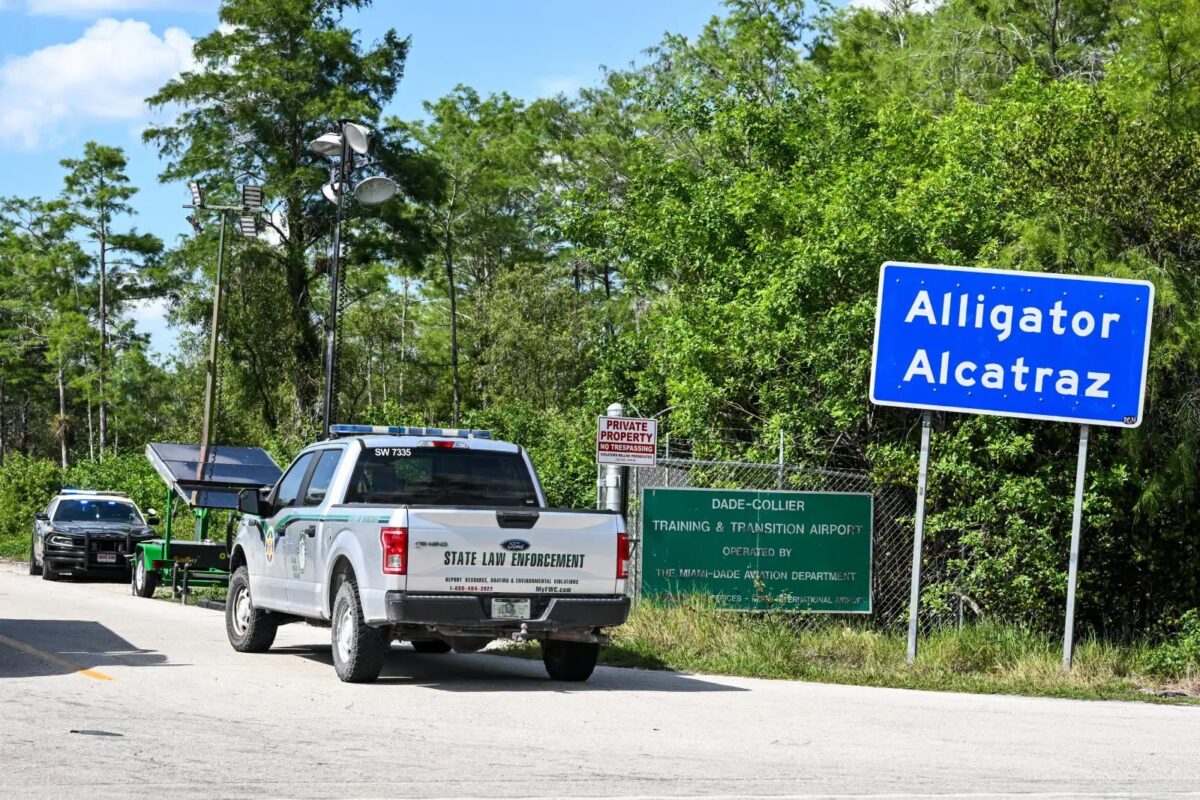
The detention center was not built in an ordinary location. It sat near the Dade-Collier Training and Transition Airport, a remote strip of pavement in South Florida surrounded by wetlands, wildlife, and protected lands. That setting helped fuel the nickname “Alligator Alcatraz,” a phrase that turned the facility into a political brand before many Americans understood how it would operate.
Florida officials framed the site as a temporary emergency solution. The state moved quickly, relying on tents, trailers, security infrastructure, generators, lighting, and transportation systems to establish a detention operation within days. From the beginning, the project was sold as fast, functional, and tough.
That speed also became one of the biggest criticisms. Civil rights groups, immigration advocates, environmental organizations, and Indigenous leaders argued that the state moved with too little transparency and too little review. They questioned whether a detention site built so quickly in such a sensitive area could safely house people, withstand severe weather, protect legal rights, and avoid damaging the Everglades.
The closure does not erase those questions. It sharpens them.
Why Florida Says the Facility Closed
Gov. DeSantis has described the facility as temporary by design. His argument is straightforward: Florida created the site to meet an urgent immigration enforcement need, and once federal authorities had enough capacity elsewhere, the state no longer needed to manage it.
Officials also pointed to hurricane season as a key reason detainees had to be moved. A soft-sided detention site in the Everglades raises obvious weather concerns. Heavy rain, flooding, heat, insects, limited road access, and storm evacuation logistics all posed practical risks that became harder to defend against as summer approached.
The detainees were transferred to other facilities before the governor’s announcement of closure. That means the shutdown was not a sudden single-day collapse. It was the final step in a process already underway, as people held at the site were moved out and the state prepared to wind down operations.
Still, the political message from Florida was clear. DeSantis presented the center as a success, saying it had served its purpose. His administration has argued that the facility helped remove thousands of people from the country and gave Florida a larger role in immigration enforcement.
The 21,000 Figure at the Center of the Political Argument
One number now dominates the public debate: 21,000. DeSantis has said the facility played a role in the deportation of 21,000 people. That figure is likely to become the headline statistic used by supporters who argue that the center was effective, necessary, and worth the controversy.
But statistics in immigration enforcement rarely tell the full story on their own. The number does not resolve questions about individual cases, legal process, detention conditions, environmental impact, or cost. It also does not answer whether the same enforcement outcomes could have been achieved without building a remote detention compound in the Everglades.
For supporters, the number shows results. For critics, it raises a different concern: how many people were moved through a rushed system with limited access to lawyers, families, courts, and outside oversight?
That split is why Alligator Alcatraz became bigger than one facility. It became a test case for how far states can go when they decide to build their own immigration enforcement infrastructure.
Claims of Harsh Conditions Follow the Facility to Its End
The closure arrives after months of complaints about conditions inside the center. Former detainees and advocates described problems involving sanitation, insects, flooding, food, access to medical care, and communication with attorneys. Those claims helped push the facility into courtrooms, onto the streets, and into national headlines.
State and federal officials have defended the detention mission and rejected the broader argument that the site was inherently unfit. But the criticism never faded. Instead, it became part of the center’s identity.
The most serious claims centered on legal access. Immigration detention is civil detention, but the consequences can be life-changing. People may be fighting deportation, seeking asylum, trying to contact relatives, or gathering documents that affect whether they remain in the United States. When attorneys say they cannot reliably reach clients, the issue becomes more than an inconvenience. It becomes a due process concern.
That is why legal fights around Alligator Alcatraz may continue even after the gates close. A shutdown can end operations, but it does not automatically end accountability questions.
The Everglades Battle Is Not Just Political
The location made the controversy even more explosive. The Everglades are not just empty land. They are one of America’s most important ecological systems, home to wetlands, protected species, tribal history, restoration projects, and a delicate water system that affects South Florida far beyond the detention site.
Environmental groups argued that the facility threatened wildlife, water quality, air quality, and the broader restoration effort. They also challenged whether the project received the environmental review expected for a major activity in such a sensitive region.
The state has emphasized that the facility was built around an existing airstrip, not carved from untouched wilderness. But environmental critics argue that even temporary infrastructure can cause lasting damage when it involves heavy equipment, lighting, sewage, traffic, generators, fuel, waste systems, and large-scale human activity in a fragile landscape.
That is one reason the closure may not satisfy environmental groups. They may still seek answers about what happened on the land, what must be removed, who pays for restoration, and whether any damage remains after the tents and trailers are gone.
A Costly Experiment With Political Consequences
The financial questions around Alligator Alcatraz may now become even more important. Temporary detention facilities can be expensive because they require rapid construction, private contractors, transportation, security, utilities, food service, sanitation, medical support, and emergency logistics.
Critics have argued that the facility cost taxpayers too much and benefited contractors while families, courts, and detainees carried the human burden. Supporters argue that immigration enforcement has costs and that Florida had to act because Washington’s system was overwhelmed.
Both arguments will matter in the next phase. Lawmakers, watchdogs, journalists, and advocacy groups are likely to keep asking how much the facility cost, which companies received contracts, whether Florida expected federal reimbursement, and whether the state received value for the money spent.
That is where the story could continue long after the physical site disappears. The public may forget the tents. The contracts, lawsuits, invoices, and court records may last much longer.
What the Closure Means for Immigration Detention Nationwide
The end of Alligator Alcatraz does not mean the end of immigration detention. It may simply mean a shift from one high-profile site to a broader network of other facilities. Detainees who moved out of the Everglades did not necessarily leave custody. Many were transferred elsewhere, spreading the same legal and humanitarian concerns across other states and detention systems.
That matters because the national debate is not just about one Florida compound. It is about whether America will rely more heavily on large, remote, temporary, or state-supported detention sites as immigration enforcement expands.
Florida’s experiment may become a model for some states and a warning for others. Governors who favor aggressive immigration enforcement may see the site as proof that states can move quickly. Civil rights and environmental groups may see it as proof that the rapid expansion of detention facilities creates dangerous blind spots.
Either way, the closure will not end the argument. It will define the next one.
Why the Name ‘Alligator Alcatraz’ Will Outlive the Facility
The nickname gave the center national recognition, but it also exposed the politics behind it. “Alligator Alcatraz” was never just a label. It projected punishment, isolation, danger, and spectacle. It turned a detention site into a message.
That message helped supporters rally behind the project. It also gave critics a powerful symbol to attack. In modern politics, names matter because they travel faster than policy documents. This one traveled across cable news, social media, court filings, protest signs, and national headlines.
The name will likely remain in public memory because it captured the tone of the debate. It suggested that immigration enforcement was not only about processing cases, but about demonstrating toughness in a way designed to be seen and repeated.
Now, with the center closed, the name becomes part of the record: a shorthand for a moment when immigration policy, environmental risk, state power, and political theater collided in the Florida wetlands.
The Closure Ends the Facility, Not the Questions
Florida’s Alligator Alcatraz immigration detention center has closed, but the issues it raised remain. The state says the site served a temporary purpose. Supporters say it helped deliver results. Critics say it caused harm, weakened oversight, and turned human detention into a political spectacle.
The next chapter will unfold in courtrooms, budget records, environmental reviews, and the lives of the people who passed through the facility. Some families will still be searching for answers. Some lawyers will still be tracking cases. Some environmental advocates will still be asking what happened to the Everglades. Some officials will still be defending the project as necessary.
That is why the closure should not be treated as the end of the story. It is the point where the visible structure disappears, and the larger consequences come into focus.
In the end, Alligator Alcatraz may be remembered less for how long it operated than for what it revealed: how quickly emergency power can build a detention system, how fiercely communities can resist it, and how difficult it becomes to separate immigration policy from the land, money, law, and human lives caught inside it.