Marjorie Taylor Greene Says Trump Officials Backing Iran War and Epstein Files Handling Could Lose 2028 Support
Former Georgia congresswoman Marjorie Taylor Greene has issued a blunt warning to members of President Donald Trump’s administration who may be considering a White House campaign in 2028: their positions today could determine whether Republican voters trust them tomorrow.
In an August 5 social media post, Greene argued that administration officials who defended the war with Iran, remained publicly silent about it, or supported the administration’s handling of the Jeffrey Epstein files should not expect dissatisfied voters to forget those choices when the next presidential race begins.
Greene did not identify any official by name. Her warning, however, arrived as Vice President JD Vance and Secretary of State Marco Rubio continue to attract attention as possible contenders for the 2028 Republican nomination. Neither man has formally announced a presidential campaign.
The former congresswoman’s message was not framed as a routine disagreement over foreign policy. It was presented as a political ultimatum.
According to Greene, officials who have defended the conflict “will not be trusted.” She also warned potential candidates that voters would not accept promises that a future administration would behave differently.
Her central argument was simple: Republican officials already hold power, so voters should judge them by what they do now rather than what they promise from a campaign stage in 2028.
Greene Turns the Iran War Into a 2028 Republican Loyalty Test
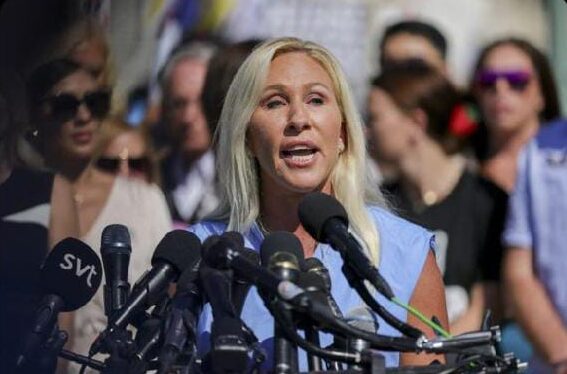
Greene’s warning represents a growing effort to make the Iran war a defining test for the next generation of Republican leaders.
For years, the modern “America First” movement presented itself as an alternative to the foreign-policy establishment that supported prolonged military engagements overseas. Trump repeatedly appealed to voters who believed Washington had spent too much money, military strength and political attention on conflicts far from home.
Greene now argues that the continuing war with Iran violates that political commitment.
“You are in power right now,” she wrote while calling on the administration to end the conflict and bring American troops home. She also told prospective candidates they should not expect to appear on debate stages offering “anti-neocon tough talk” after supporting the administration’s current policies.
Her criticism carries additional weight because she was once among Trump’s most visible and aggressive defenders. Greene entered Congress in 2021 as a vocal supporter of the president and his political movement. Her eventual break with Trump demonstrated how disputes over foreign intervention and government transparency could divide even prominent figures who previously appeared firmly united.
That division had already surfaced earlier in the conflict. In March, Greene warned that Trump’s Iran policy could damage Republicans in the 2026 midterm elections. She accused the administration of abandoning campaign promises involving foreign wars and regime change. Conservative media personalities, including Tucker Carlson and Megyn Kelly, also questioned the military operation, although their arguments and language differed.
The August warning goes further. Greene is no longer discussing only the next congressional election. She is attempting to carry the dispute directly into the 2028 Republican presidential primary.
In effect, she is asking voters to keep a record: Who defended the war? Who challenged it? Who remained silent? And who later attempted to present themselves as the candidate most committed to ending foreign entanglements?
The Conflict Is Becoming Harder for Republican Candidates to Avoid
Greene’s statement came while the United States remained deeply involved in a conflict that had already lasted approximately five months.
On August 6, Trump said he believed the war would end “pretty soon,” while acknowledging that supplies of some categories of American munitions were tighter than others. Reuters reported that the U.S. Army had consumed much of its global stockpile of certain highly accurate, long-range missiles during the conflict. Trump said defense manufacturers were expanding production, including the construction of facilities for Patriot and Tomahawk missiles.
Those developments make the conflict difficult to treat as a distant or temporary political issue. Questions about military readiness, American casualties, regional retaliation, energy prices and the duration of the operation could remain relevant well beyond the immediate fighting.
Iran has also attempted to increase pressure on Washington through American allies in the Gulf. Iranian officials warned regional governments that infrastructure, including oil, electricity and water facilities, could face retaliation if the United States launched further attacks. That warning reinforced concerns that the conflict could expand beyond the direct confrontation between Washington and Tehran.
For potential 2028 candidates serving in the administration, this creates a difficult political calculation.
Openly opposing Trump could weaken their standing inside an administration where loyalty remains valuable. Defending the war, however, could create problems with Republican voters who embraced Trump partly because he promised to avoid costly foreign interventions.
Silence carries its own risk. Greene’s post specifically targeted officials who had not publicly opposed the conflict, suggesting that remaining neutral would not protect them from future criticism.
We should be clear that Greene has not demonstrated that Republican voters as a whole share her position. No primary votes have been cast, the 2028 field remains unsettled, and public attitudes could change substantially before campaigning begins. Her post is best understood as an attempt to establish the standards by which future candidates will be judged.
The Epstein Files Remain Part of Greene’s Warning
The Iran conflict was only one part of Greene’s argument. She also accused administration officials of supporting what she described as a cover-up involving the Epstein files.
The issue has been central to her political separation from Trump.
Greene supported congressional efforts to compel the release of government records connected to Jeffrey Epstein. Her alliance with lawmakers demanding greater transparency contributed to a public confrontation with Trump, who called her a “traitor” after she broke with him. Congress later passed the Epstein Files Transparency Act by an overwhelming margin, requiring the Justice Department to release records covered by the legislation. More than three million files had been published by early March, although arguments continued over redactions, withheld information and whether the release fulfilled the public demand for complete transparency.
Greene’s August post insisted that the files had still not been fully released. She linked that dispute to the Iran war, presenting both as examples of officials failing to deliver what parts of the Republican base believed they had been promised.
That combination is politically significant.
Foreign policy and the Epstein records may appear to be unrelated subjects, but Greene has placed them under the same broader question: Can Republican voters trust leaders who campaign against establishment power but defend the government once they control it?
Her accusation is political, not a proven finding that every administration official participated in a cover-up. The distinction matters. Greene is presenting her interpretation of the administration’s conduct and attempting to persuade voters to adopt it as a test of credibility.
JD Vance and Marco Rubio Face Growing 2028 Speculation
Although Greene named no individual, her statement inevitably raises questions about the administration officials most commonly discussed as possible Trump successors.
Trump has publicly praised both Vance and Rubio. In June, he described the possibility of the two men running together as a potentially formidable Republican ticket, although he did not say which one should seek the presidency. Vance has played down campaign speculation, while Rubio has previously indicated that he would support Vance if the vice president entered the race.
Greene’s warning should not be rewritten as a direct attack on either man. Without names, such a claim would go beyond what she actually said.
Still, her post creates a political challenge for every administration figure with national ambitions. Any official seeking the Republican nomination may eventually have to explain his or her role in the Iran conflict, position on military escalation and response to demands for additional Epstein-related disclosures.
Greene herself has denied that she plans to run for president. Before leaving Congress, she said she was not interested in enduring the fundraising, constant travel and personal sacrifice required for a national campaign.
Her influence on the race, therefore, may come not as a candidate but as a critic attempting to shape the Republican debate from outside elected office.
Greene officially resigned from the House on January 5, 2026. The Office of the Clerk now supervises the staff serving Georgia’s 14th Congressional District until a replacement is elected.
Greene’s Warning Exposes a Larger Fight Over the Future of MAGA
The most important element of Greene’s statement is not the personal hostility that followed her break with Trump. It is the unresolved struggle over what “America First” should mean after Trump leaves office.
One faction may continue to define the movement primarily through loyalty to Trump and his administration. Another may argue that its principles, including opposition to long wars, elite secrecy and unaccountable institutions, must take priority over loyalty to any one leader.
Greene has clearly placed herself in the second camp.
Her declaration that “we won’t vote for you anymore” is not a verified prediction of how millions of Republicans will behave in 2028. It is a warning that the next Republican nominee may not inherit Trump’s coalition automatically.
The candidates who eventually compete for that coalition will have to defend more than their campaign slogans. They may have to explain what they did when American forces were fighting in Iran, what they said when voters demanded fuller disclosure of government records, and why Republican voters should believe their promises after watching them exercise power.
The 2028 election remains years away, but Greene is already trying to define one of its central questions: When the Trump era ends, will Republican voters reward the officials who protected his administration or the figures who challenged it?