Appeals Court Rejects Trump Bid to Curb Mail-In Voting in 23 States
A federal appeals court has refused to let President Donald Trump’s administration immediately enforce major parts of a sweeping mail-in voting order across 23 states and the District of Columbia. The 2-to-1 decision keeps a lower court injunction in place as election officials prepare for September primaries and the November 2026 congressional elections.
The ruling represents a significant legal setback for the administration’s attempt to reshape how states identify eligible voters, prepare absentee ballots and use the United States Postal Service during federal elections. It also pushes the dispute closer to the Supreme Court, where the Justice Department has indicated it may seek emergency intervention.
Court Leaves Lower Court Injunction in Place
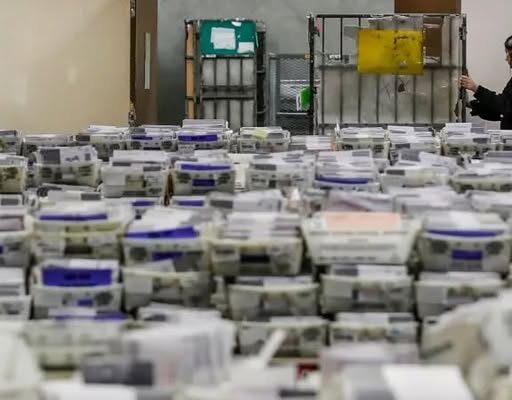
The Boston-based First US Circuit Court of Appeals rejected the administration’s emergency request to pause a ruling issued by US District Judge Indira Talwani. Her order prevents federal agencies from implementing key provisions of Trump’s executive order in the states that brought the lawsuit for federal elections held on or before November 3, 2026.
The appeals court did not issue a final judgment on every constitutional question raised by the order. Instead, it concluded that the administration had failed to meet the demanding legal standard required to suspend the injunction while the broader appeal proceeds.
That distinction matters. Trump’s policy has not been permanently defeated, but the administration cannot use the contested provisions in the plaintiff states during the approaching 2026 elections unless a higher court intervenes or the government later succeeds on appeal.
Judges Say States Must Prepare Now
The Justice Department argued that the lawsuit was premature because the Department of Homeland Security and the Postal Service had not completed every policy needed to implement the executive order. According to the administration, states should have waited until the agencies took final action before challenging the plan.
The appeals court majority rejected that position. It found that the executive order established firm deadlines and detailed procedures that were already forcing state officials to redirect staff, examine new data systems, prepare election workers, and consider replacing ballot materials.
The judges concluded that the states had “no practical choice” but to respond immediately. Election preparation begins months before voters receive their ballots, and officials cannot wait until the final days of a campaign to redesign envelopes, retrain local workers or explain new voting procedures to millions of residents.
Court records showed that nearly half of the states involved had already purchased mail ballot envelopes for the 2026 election cycle. Those materials could have become noncompliant under the proposed federal standards, potentially forcing election offices to order replacements at additional cost.
What Trump’s Executive Order Would Change
Trump signed Executive Order 14399 on March 31, calling it an effort to strengthen citizenship verification and protect the integrity of federal elections. The directive placed the Department of Homeland Security, the Social Security Administration, the Justice Department and the Postal Service at the center of a new federal election system.
Under the order, Homeland Security would compile lists of people confirmed through federal records as US citizens, at least 18 years old and residing in each state. Those citizenship lists would be transmitted to state election officials at least 60 days before regularly scheduled federal elections.
The order also directed the Postal Service to develop new rules for mail-in and absentee ballots. Proposed requirements included official election markings, unique tracking barcodes and state-specific participation lists identifying voters authorized to receive or return ballots through the mail.
The Postal Service would have been able to restrict the transmission of ballots connected to voters who did not appear on the required participation lists. A final Postal Service rule was expected by July 29, only months before the November election.
Trump’s directive also told the Justice Department to prioritize investigations and possible prosecutions involving state officials, ballot producers or other organizations that provided federal ballots to people considered ineligible. It authorized federal officials to consider withholding funds from states or localities when permitted by law.
States Challenged Federal Control of Elections
The lawsuit was brought by a coalition including California, Massachusetts, Nevada, Washington, Arizona, Michigan, New York, Wisconsin and other states, as well as the District of Columbia and Pennsylvania Governor Josh Shapiro. They argued that the executive order intruded on powers assigned to states and Congress under the Constitution.
Judge Talwani agreed with significant parts of their case. She declared Sections 2 and 3 of the order unlawful, finding that the president lacked authority to create a federal voter eligibility structure for states and that the Postal Service did not possess statutory power to impose binding mail voting regulations of this kind.
The lower court also raised concerns about the accuracy of the proposed citizenship lists. Federal databases may confirm many citizens, but the absence of a person’s name would not necessarily prove that the individual is a noncitizen or ineligible to vote.
The government acknowledged during the litigation that the lists would be incomplete. The appeals court said this created a credible concern that eligible voters could be excluded or that local officials might face investigations after issuing ballots to citizens whose names were missing from federal records.
Appeals Court Points to Financial and Administrative Harm
The majority found that the order was already affecting state election operations. Connecticut officials, for example, had begun examining the technical requirements for transmitting large amounts of confidential election and citizenship information to federal agencies.
Other states had diverted personnel from voter education, new voting technology and legally required election preparations. The record showed that officials were developing compliance plans even though the federal government had not offered financial assistance for the additional work.
These costs were not simply political objections or speculative fears, the judges concluded. They were immediate operational consequences produced by a policy aimed directly at the officials responsible for administering federal elections.
The court also rejected the administration’s claim that keeping the injunction in place would create an unworkable two-tier postal system. The judges said the government had not adequately explained why the Postal Service could not use different procedures in participating and nonparticipating states.
The Court Was Divided Over Citizenship Lists
Circuit Judge Gustavo Gelpí and Judge Julie Rikelman formed the majority, while Judge Melissa DuBose Dunlap agreed with part of the decision and dissented from another part. Dunlap would have partially lifted the injunction covering the Department of Homeland Security’s citizenship lists and some Justice Department enforcement provisions.
She reasoned that the citizenship list provision merely required the federal government to provide information to states and did not expressly force state officials to remove voters or change registration records. In her view, potential harm from that section remained too speculative to justify blocking it completely.
However, Dunlap agreed that the government had not justified lifting the injunction against the Postal Service provisions. She recognized that states had already ordered envelopes and faced unavoidable deadlines for distributing, receiving, and processing mail ballots.
That partial agreement highlights the strongest element of the states’ case. Whatever uncertainty surrounds the federal citizenship databases, the postal rules would have produced direct and rapid changes to physical ballots, election mail systems and voter access.
The Ruling Has Important Limits
The injunction applies only to the 23 plaintiff states and the District of Columbia for federal elections occurring on or before November 3, 2026. It does not prevent federal agencies from enforcing the order in states outside the lawsuit, including the 12 Republican-led states that intervened in support of the administration.
It also does not stop agencies from preparing policies that could apply nationwide after the November election. The legal battle therefore remains alive, even though the immediate attempt to enforce the disputed rules across the plaintiff states has been blocked.
This could create different mail voting procedures across the country. Voters in states protected by the injunction may continue under existing systems, while other states could face new federal requirements if the administration moves ahead and those measures survive separate legal challenges.
Supreme Court Fight May Be Next
The Justice Department previously warned that it might ask the Supreme Court to intervene if the First Circuit refused to suspend Talwani’s injunction. Such a request would place the dispute before the justices on an emergency basis, potentially producing another major election ruling only months before Americans vote.
The broader appeal will also continue in the First Circuit. During the stay proceedings, the administration focused primarily on whether the states had standing and whether their lawsuit was filed too early, rather than presenting a full defense of the executive order’s constitutionality.
The central issue now reaches beyond barcodes, envelopes, or federal databases. The case asks how far a president may go in directing election procedures without new legislation from Congress, particularly when those instructions collide with systems created and operated by individual states.
For election officials, the ruling provides temporary certainty as deadlines approach. For the Trump administration, it creates another obstacle in a continuing campaign to tighten voting rules following years of unsupported claims that widespread fraud determined the outcome of the 2020 presidential election.
The next court decision could determine whether this order remains a limited experiment outside the plaintiff states, disappears from the 2026 election entirely, or becomes the foundation for a new national fight over who controls the machinery of American voting.