Elizabeth Banks Turns to ‘The Hunger Games’ as She Questions White Women Who Backed Trump
Elizabeth Banks began talking about books and one of her best-known movie roles. Then the conversation moved from the fictional politics of Panem to the very real voting booth.
During an April 14 appearance on Bustle’s One Nightstand podcast, the actress reflected on Effie Trinket, the extravagantly dressed Capitol escort she portrayed in The Hunger Games films. Banks praised the character’s transformation from a willing participant in an oppressive system into someone prepared to challenge it.
That discussion quickly became a pointed message for white women who supported Donald Trump over Kamala Harris in the 2024 presidential election.
“I don’t understand the 53% of white ladies that didn’t vote for Kamala. What were you thinking?” Banks said.
The comment turned a promotional interview into a fresh debate about celebrity politics, voter priorities and what the 2024 election results actually revealed.
Banks Sees Effie Trinket as a Political Lesson

Banks appeared on the podcast shortly after the April 9 release of her Peacock series The Miniature Wife, in which she stars opposite Matthew Macfadyen. The interview focused largely on books that shaped her career and the stories she has wanted to bring to the screen.
Naturally, The Hunger Games entered the conversation.
Banks played Effie in all four movies from the original franchise. At first, the character is a polished representative of the Capitol who enthusiastically participates in a system that forces children to fight to the death. Her loyalty begins to crack after Katniss Everdeen and Peeta Mellark are ordered back into the arena in Catching Fire.
Banks described Effie’s development as one of the greatest character arcs she has portrayed. The actress argued that Effie gradually recognizes the injustice around her because she develops genuine affection for the people being harmed by the system.
“I wish more of us were becoming revolutionaries,” Banks said before presenting Effie as an example of someone capable of changing sides after confronting an uncomfortable reality.
It was a characteristically theatrical way to make a political point. Banks did not simply criticize Trump voters. She used a fictional woman dressed in Capitol couture to argue that people can question a system they once accepted and ultimately reject it.
Banks’ comparison also reflected her own interpretation of Trump-era politics. She described the government in The Hunger Games as fascist and suggested that Effie’s decision to turn against it carried a lesson for the present day.
What the 53 Percent Figure Actually Represents
The statistic behind Banks’ comment came from national exit polling that estimated 53 percent of white women who cast ballots supported Trump in 2024.
There is an important distinction, however. The figure does not mean 53 percent of every white woman in the United States voted for Trump. It refers to white women who participated in the election and were represented in the exit-poll sample.
Banks also phrased the number as the share who “didn’t vote for Kamala.” Exit polls more specifically measured support for Trump, with smaller numbers of voters choosing third-party candidates or leaving the presidential race blank.
Later research using validated voters produced a slightly different estimate. Pew Research Center found that white women favored Trump by four percentage points in 2024. Pew also found that women overall favored Harris by seven points, showing that race, education, party loyalty and other factors remained important divisions within the female electorate.
The available evidence can show how groups voted, but it cannot establish one universal reason every white woman selected Trump.
AP VoteCast found that Trump supporters were especially focused on inflation, the economy and immigration. Harris supporters were more likely to describe the future of democracy as a major motivation, with abortion, health care and climate change also influencing parts of her coalition.
Those findings help explain why Banks’ question has no single answer. Millions of voters were weighing different concerns, and many did not view the election through the same reproductive-rights and democracy-focused lens emphasized by Harris and her celebrity supporters.
The White House Fires Back
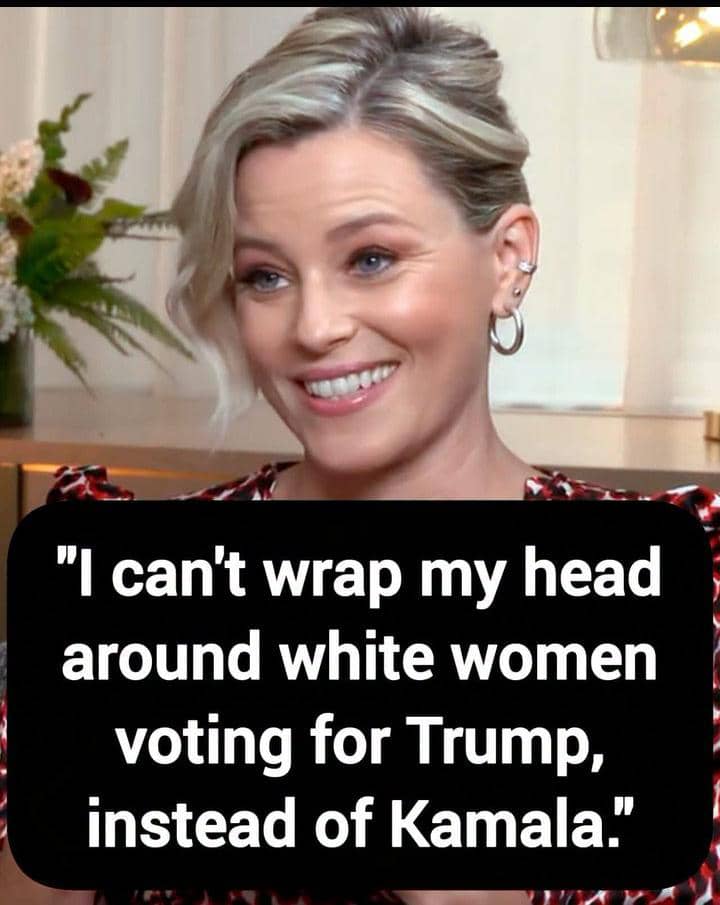
Banks’ remarks did not go unanswered.
White House spokesman Davis Ingle dismissed the actress’s criticism in a statement to Fox News Digital.
“Nobody in their right mind cares what out-of-touch woke celebrities in Hollywood say or think,” Ingle said.
The response followed a familiar political script. A celebrity criticizes Trump, Trump’s team portrays the celebrity as disconnected from ordinary Americans, and both sides use the exchange to reinforce what their supporters already believe.
Banks has never hidden her Democratic leanings. She supported Hillary Clinton during the 2016 election and appeared at that year’s Democratic National Convention, where she used Effie Trinket to mock Trump’s dramatic entrance at the Republican convention.
“When I tuned into Cleveland last week, I thought, ‘Hey, that’s my act,’” Banks joked during that appearance.
Her latest comments therefore represent continuity rather than a sudden entry into politics. Banks has spent years using her entertainment career, and particularly her association with The Hunger Games, to criticize Trump and support Democratic candidates.
Still, her question about white women reaches beyond Hollywood banter. It highlights one of the Democratic Party’s stubborn electoral problems. Appeals centered on gender solidarity do not automatically overcome differences involving ideology, religion, education, geography, economic anxiety or party identification.
Banks clearly believes more women should experience an Effie Trinket-style political awakening. The election data show that many white female voters saw the choice differently.
That disagreement will not be settled by one podcast interview. But Banks certainly found a memorable way to restart the argument.