Kamala Harris Says Trump’s USAID Cuts May Have Cost Up to 700,000 Lives. Here’s What the Evidence Shows
Former Vice President Kamala Harris is putting an extraordinary number at the center of her latest attack on President Donald Trump’s foreign policy.
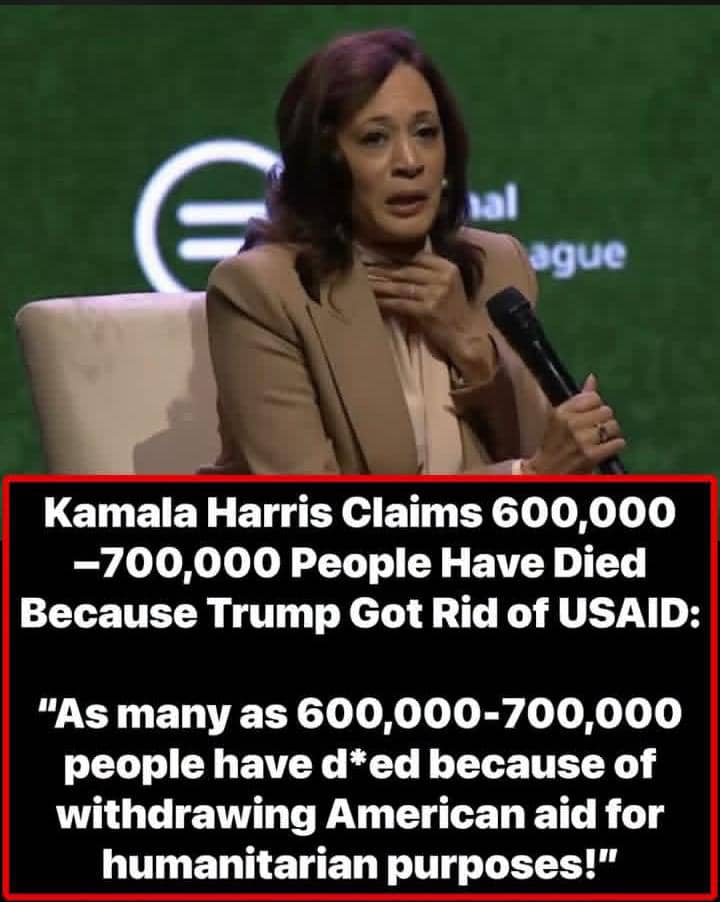
In a video circulating online, Harris called the dismantling of the U.S. Agency for International Development “unbelievable”. He said as many as 600,000 to 700,000 people had died because the United States withdrew humanitarian assistance.
The statement fits Harris’s broader criticism of Trump’s approach to America’s role overseas. During an appearance at the National Action Network convention in New York, she argued that the United States had become less reliable and was losing influence under Trump.
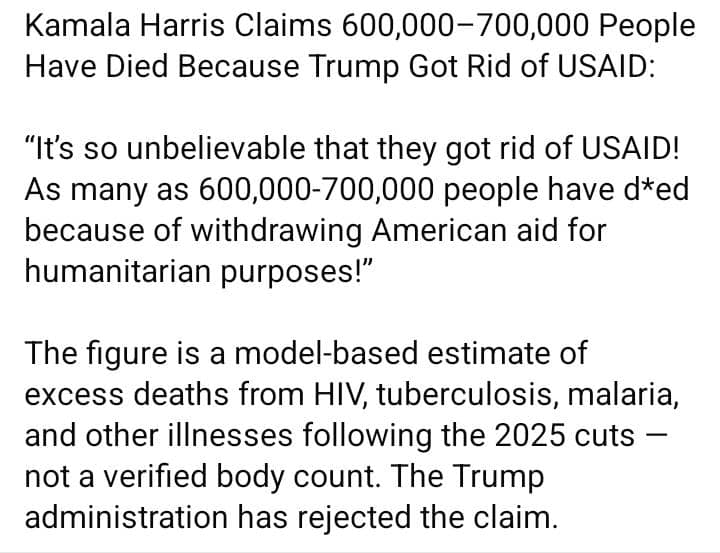
But the enormous death toll requires an important explanation. The figure is not an official count of people whose deaths have been individually investigated. It comes from public-health models estimating the number of additional deaths likely caused by the sudden disappearance of medical treatment, food assistance and disease-prevention programs.
Where Harris’s 700,000 Figure Comes From
One major source is the Impact Counter project developed by Boston University global-health researcher Brooke Nichols and other specialists.
The project estimated the consequences of disrupted or terminated programs involving HIV, tuberculosis, malaria, pneumonia, diarrhea, and childhood malnutrition. At the end of its one-year tracking period, the dashboard projected 262,915 additional adult deaths and 518,428 child deaths connected to the funding interruptions.
That produces a total above 780,000. However, the dashboard describes the numbers as projected deaths, not a list of confirmed fatalities. Its models were designed to calculate how many people would probably die when treatment, prevention, and nutrition services vanished.
Researchers at the Center for Global Development reached a similar range using a different method. Charles Kenny and Justin Sandefur examined the amount of health and humanitarian spending that disappeared, then combined it with existing research on how many lives those programs typically saved.
Their December 2025 update estimated between 500,000 and one million deaths based on reduced spending. Estimates based on future funding commitments ranged from approximately 670,000 to 1.6 million. The researchers openly described their calculations as “ballpark estimates” because incomplete government data made exact measurement difficult.
Atul Gawande, a surgeon and former USAID global-health administrator, has also cited an estimate of more than 700,000 deaths. He said the number was supported by both the Boston University modeling and research examining USAID’s long-term effect on mortality.
Gawande nevertheless acknowledged that “the precision of the numbers is a question.” His broader argument was that the evidence points to at least tens of thousands, and probably hundreds of thousands, of preventable deaths.
A separate Lancet study offered a longer-term warning. It projected that continued cuts could contribute to more than 14 million additional deaths by 2030, including approximately 4.5 million children younger than five. That study examined USAID’s impact across 133 low- and middle-income countries and compared continued assistance with the sharply reduced funding announced in 2025.
Why the Number Is an Estimate, Not a Confirmed Body Count
Deaths caused by humanitarian cuts do not normally appear on certificates under the heading “USAID closure.”
A child may officially die from malaria after mosquito-net distribution ends. A tuberculosis patient may die after a clinic closes. A malnourished infant may die after therapeutic food deliveries stop. Statistical models attempt to determine how many such deaths occurred above the number expected if the programs had continued.
That does not make the models meaningless. Governments and health organizations regularly use excess-mortality calculations when complete records are unavailable. But it does mean Harris’s statement needs careful wording.
The strongest factual version would be that researchers estimate the cuts contributed to between 600,000 and 700,000 deaths. Saying flatly that 700,000 people definitely died can make the figure sound more certain than the available data allows.
Gawande said reliable mortality information could take several years to compile, partly because USAID previously helped collect health data in the countries where it worked. He also said researchers and journalists had individually documented about 1,200 deaths directly connected to the loss of assistance, while broader estimates necessarily relied on modeling.
The evidence therefore sits between two extreme positions. There is no verified ledger proving exactly 700,000 deaths. At the same time, there is substantial research, field reporting and documented loss of services showing that the death toll is not zero.
Trump Officials Defend the Overhaul as Critics Point to the Human Cost
Trump’s administration has described the USAID overhaul as an effort to eliminate waste, ideological spending and programs that did not advance American interests.
The White House accused the agency of sending money to poorly supervised or inappropriate projects. The State Department later said approximately 85 percent of USAID programs had been cut, with surviving operations transferred into a new foreign-assistance structure.
Secretary of State Marco Rubio argued that every foreign-aid program should make the United States “safer,” “stronger” or “more prosperous.” He said the administration would continue humanitarian and food assistance, but insisted that foreign aid should serve as a tool of national policy rather than operate as independent charity.
Elon Musk, who helped lead the Department of Government Efficiency effort behind the cuts, has rejected accusations that the overhaul caused deaths.
“Zero died because of DOGE. Zero. Point. Zero,” Musk said during a July interview with The Economist. He suggested that private foundations could have responded more quickly where assistance was needed.
That sweeping denial faces its own credibility problem. Even without accepting the upper estimates, researchers have documented major disruptions to malaria prevention, HIV treatment, tuberculosis services, nutrition programs and emergency healthcare.
A July 2026 State Department inspector general’s report also found that staffing shortages, information-technology problems and delayed guidance hindered the rapid transfer of USAID’s surviving programs. The State Department defended the new structure, saying American assistance had become faster and more accountable.
Harris’s claim therefore has a credible research foundation, but it should not be presented as an exact, officially confirmed death count. The honest conclusion is more precise and no less serious: multiple independent models estimate that several hundred thousand preventable deaths may have followed the abrupt reduction of American humanitarian assistance.
The final number may take years to establish. The political fight over who bears responsibility is already fully underway.