David Hockney Dies at 88: The Brightest Rebel in Modern Art Leaves Behind a World Painted in Color
David Hockney did not simply paint the world. He made people notice it again.
The celebrated British artist, famous for his electric swimming pools, sharp portraits, restless experiments, and fearless love of color, has died at 88. His death closes one of the most recognizable careers in modern art, but it also reopens a larger question: how did one man from Bradford become the artist who taught the world to look at sunlight, water, faces, roads, trees, and windows differently?
Hockney’s career stretched across more than six decades, but he never allowed himself to become trapped in one era. He moved from British Pop Art to California pools, from intimate portraits to photo collages, from Yorkshire landscapes to iPad drawings in Normandy. He was not just a painter of pretty scenes. He was a restless visual thinker who kept challenging the rules of art until the end.
The Bradford Boy Who Refused to Stay Small
Hockney was born in Bradford, England, in 1937, far from the glossy Los Angeles world that later shaped his fame. His early life was not built around luxury, celebrity, or art-market glamour. That made his rise even more striking.
He studied at Bradford School of Art before moving to London’s Royal College of Art, where he emerged during the exciting British Pop Art wave. Even then, Hockney carried a rebellious streak. He did not want art to feel cold, closed, or reserved for insiders. He wanted it to feel alive.
That attitude helped make him different. His paintings were intelligent but also welcoming. They had humor, confidence, desire, and brightness. He understood that serious art did not have to look miserable.
California Turned Him Into a Global Name
Hockney’s move to California changed everything. Los Angeles gave him what gray northern England could not: hard sunlight, open space, modern homes, blue pools, and a sense of personal freedom.
His famous pool paintings became visual shorthand for a whole dream of California life. Works like A Bigger Splash captured a strange magic. The person who jumped into the water is gone, but the splash remains frozen in time. That was Hockney’s gift. He could make a quiet scene feel charged with movement.
California also gave him a new language for identity. At a time when gay life was often hidden, judged, or pushed to the margins, Hockney placed intimacy, male beauty, and private relationships inside his art with unusual directness. He did not turn his life into a slogan. He simply refused to erase it.
His Paintings Became Richer Than His Celebrity
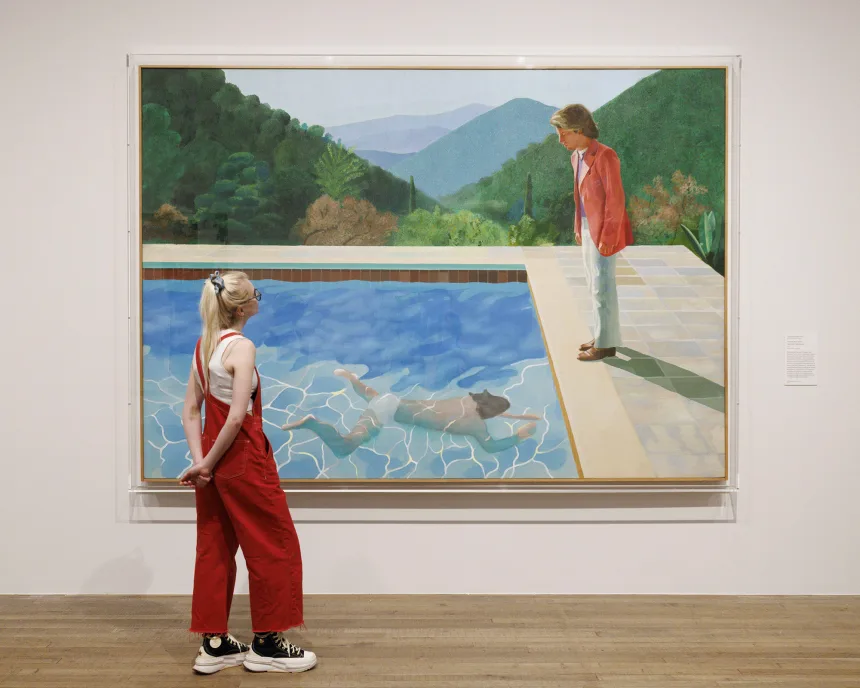
Hockney became famous, but his work outgrew fame. His 1972 painting Portrait of an Artist (Pool with Two Figures) became one of the most talked-about modern artworks after selling for $90.3 million in 2018. The sale made headlines, but the painting’s emotional power had always been deeper than its price.
The image is calm on the surface. A swimmer moves beneath the water. A dressed man stands above, looking down. Yet the distance between them feels heavy. It is a painting about beauty, longing, separation, and silence.
That emotional sharpness is why Hockney lasted. His colors attracted people first, but his deeper questions kept them there.
He Never Stopped Changing His Tools
Some artists become prisoners of their most famous style. Hockney did the opposite.
He worked with acrylic paint, drawing, photography, stage design, fax machines, photocopiers, video, digital tools, and iPads. He treated technology not as a threat to art, but as another brush. That made him feel unusually modern even in old age.
His iPad drawings, especially his late landscapes, proved that curiosity has no age limit. For Hockney, a screen could still hold spring light, moving branches, wet fields, and blooming trees. He kept finding new ways to make people look.
Yorkshire and Normandy Gave His Late Work New Fire
Later in life, Hockney returned to nature with fresh intensity. Yorkshire gave him rolling roads, trees, hedges, and seasonal drama. Normandy gave him gardens, blossoms, and quiet rural views.
These works were not an old man retreating from the world. They were an artist sharpening his attention. Hockney seemed to understand that ordinary landscapes become extraordinary when someone really watches them.
That may be one of his final lessons. A tree is not just a tree. A road is not just a road. A pool is not just a pool. Everything changes when light hits it, when memory touches it, when an artist decides it matters.
The Art World Is Mourning More Than a Painter
The tributes following Hockney’s death show the size of the space he leaves behind. He was remembered as a giant of British art, a rule-breaker, an innovator, and one of the most beloved artists of his generation.
But his public appeal came from something simple: people could recognize themselves in his pleasure. His work gave permission to enjoy color, beauty, desire, humor, and daily life without apology.
Hockney made modern art feel less like a locked room and more like an open window. Through that window, people saw California pools, Yorkshire roads, Normandy trees, friends, lovers, dogs, flowers, and rooms filled with light.
David Hockney is gone, but his vision remains stubbornly alive. Every bright pool, every sharp shadow, every spring tree, and every burst of blue now carries a little of the world he taught millions to see.